






























In a case brought on its own initiative, the Supreme Court has issued notices to AGP and other parties.
Judge Shah wants to know if it is possible to reestablish assemblies if the Constitution was violated by dissolving them without providing a justification.
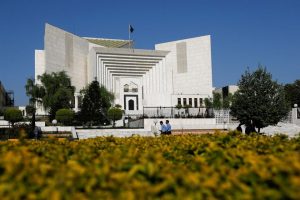
In the suo moto case concerning the postponement of elections in Punjab and Khyber-Pakhtunkhwa, the Supreme Court on Thursday sent letters to the attorney general of Pakistan (AGP) and other parties (K-P).
The question of the delay in holding elections in the two provinces was heard today by a nine-member bigger bench under the leadership of Chief Justice of Pakistan (CJP) Umar Ata Bandial.
Justices Ijazul Ahsan, Muneeb Akhtar, Mazhar Ali Naqvi, Muhammad Ali Mazhar, Yahya Khan Afridi, Mansoor Ali Shah, Athar Minallah, and Justice Jamal Khan Mandokhail make up the bigger bench.
The CJP opened the proceedings by stating that the court needed to hear three cases on the topic and that the election date had been declared by the president of Pakistan.
He added that the court was running out of time and the polling period was closing in.
Barrister Ali Zafar, the lawyer for Pakistan Tehreek-e-Insaf (PTI), approached the podium to “put things on record relating to the president.”
The CJP stated that the circumstances changed when the president announced the election date on February 20 and that “the petitions [filed in the case] are now out of date and need clarification.”
He insisted that the speakers of the two provincial assemblies include questions to their petitions. The Supreme Court merely needs to recognise and apply the constitutional point, he said.
AGP Shehzad Ata Elahi asked for more time for the case, arguing that if many individuals received notices, it would be difficult to prepare for it by tomorrow.
The CJP said, “Tomorrow, we will limit ourselves to a few necessities,” adding that a thorough hearing of the case would take place on Monday.
Elections must take place within “90 days, and time was flying swiftly,” Justice Bandial continued. He stated that although the case was still before the top court, no ruling had been made.
Judge Mandokhail stated in his remarks that “the petition of the speaker of the two assemblies is before us,” adding that Justice Ahsan and Justice Naqvi had taken suo motu notice.
He said that the chief justice did not have enough time to undertake a lengthy hearing.
Everyone would gain if the choice to have elections, according to attorney Shoaib Shaheen. Judge Minallah responded that a court decision would be advantageous to all parties.
Advocate Shaheen stated, “This is a time-bound situation where there is a question of having elections.
When discussing the uncertainties in the case, Justice Minallah pointed out that the first issue would be whether or not the assembly was dissolved in accordance with the Constitution. The second question, he continued, is whether the parliament should also consider the Constitution’s Article 184(3).
If the assemblies were dissolved without cause in contravention of the Constitution, Judge Syed Mansoor Ali Shah questioned whether they could be reconstitute.
The CJP Bandial argued that the president announced elections in accordance with Section 57 of the Constitution and that these questions will be added for the decision of this subject.
The PTI’s application was still pending and should also be heard, according to attorney Ali Zafar. The CJP said that the top court was currently hearing three cases.
On the recommendation of two bench members on the announcement of elections in Punjab and K-P, Judge Jamal Khan Mandokhail raised grave qualms about the use of suo motu jurisdiction.
He read the written letter he had composed, in which he made reference to the audio leaks about the fixation of the matter before a specific bench or judge.
The AGP, all advocate generals, the deputy chairman of the Pakistan Bar Council, and the PDM parties received notices from the bigger bench in the meantime.
The court postponed the case’s hearing until tomorrow (Friday).
When the stakeholders’ disagreements over the electoral law continue to effectively paralyse the election process, CJP Bandial intervened and took suo motu notice of the delay in holding elections in Punjab and K-P.
A division bench of the Supreme Court had referred the case to the CJP for exercising suo motu jurisdiction last week, citing an impending risk of constitutional breach.
When Ghulam Mehmood Dogar, who had been returned to the federal government, filed a petition, the court made it clear that it would not rule on the election issue because it was not on the bench.
A growing rift between rival political parties, primarily the PTI and the Pakistan Democratic Movement (PDM), as well as a “imbroglio of indecision” that was roiling the protracted consultations between the Election Commission of Pakistan (ECP) and the relevant authorities contributed to the development.