


































In the election delay issue, the Supreme Court has called upon political leadership. The apex court has ordered that government poll money be released by the 27th.
ISLAMABAD: The Supreme Court summoned the leaders or representatives of all political parties, including the Jamaat-e-Islami, on Thursday (today), making it clear that it would not renege on its April 4 ruling to hold the elections in Punjab on May 14.
Additionally, it ruled that the defense ministry’s request to hold elections simultaneously throughout the nation was inadmissible.
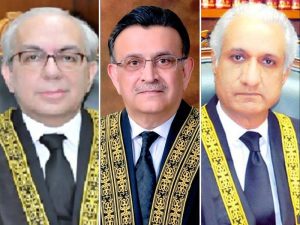
The petition regarding the Punjab elections was heard by a three-judge panel that included Chief Justice of Pakistan Umar Ata Bandial, Justice Ijazul Ahsan, and Justice Munib Akhtar.
While considering the defence ministry’s motion, the supreme court also cautioned the government of “serious consequences” if it did not release the money needed for holding elections in Punjab and Khyber Pakhtunkhwa.
The learned attorney general was therefore instructed to call the federal cabinet’s and the prime minister’s attention to the aforementioned so that the issue can be resolved as soon as possible. The court demands that all necessary corrective actions be taken by April 27, 2023, and, in particular, that the commission responsible for organising the general elections for the Punjab and KP assemblies receive Rs21 billion by that date in immediately available and realisable funds.
The bench noted in its ruling that the petitioner’s attorney placed a strong focus on free and fair elections.
Additionally, it stated that the petitioner believed that the political parties running in the general elections should respect and understand one another.
The petitioner claimed that the results of the elections at one time were superior to those of the elections in 1970 and 1977, the order continued.
Elections are contested in the political arena, and these can be best conducted with the feedback and input of all electoral political forces in the country [that] would contest in such elections, the decision stated. “Prima facie, the submission made by the learned counsel appears to have substance,” it added.
Read Sana categorically rejects holding elections on May 14
However, it continued, “the court considers that the alternative route proposed by the learned counsel cannot operate to negate or erase the date fixed by the court in its judgement dated 04.04.2023, which is in accordance with the Constitution.
Time is of the essence in examining the course suggested by the learned counsel, the order stated. “This is for the reason that political dialogue must not be made a means of avoiding the imperative obligation under Articles 112 and 224 of the Constitution… to hold a general election to a provincial assembly with 90 days of its dissolution.
The court also expressed appreciation for the petitioner’s initiative in suggesting the start of a political discussion as a method of determining a realistic and workable timetable for general elections, which satisfied the requirements of Article 218(3) of the Constitution.
The Jamaat-e-Islami through its Ameer has been given notice to arrange for their representation through their duly authorised and instructed senior office bearers of the respective parties to appear in person before the court tomorrow (Thursday) while keeping the time constraint in mind. According to CPC Order 27A, notice must also be given to the Federation of Pakistan, Pakistan’s Election Commission, and Pakistan’s Attorney General. Office shall send the notices via the legal means, including special messenger, and shall ask the print and electronic media to inform the relevant political parties of the court’s order.
A day earlier, the defence ministry petitioned the SC to have elections held on the same day nationwide and to vacate the court’s directive that the elections in Punjab take place on May 14.
The ministry emphasised in its assessment that due to the nation’s deteriorating security situation, the polls must be held on the same day.
The study also stated that by early October, the military will be prepared to handle election-related tasks.
The CJP noted that the matter had carried on for too long at the beginning of the hearing and requested that the report from the finance ministry be read aloud in the courtroom by Attorney General for Pakistan (AGP) Mansoor Awan.
The top court stated in a separate decision that the AGP’s plea could not be considered or relief provided since the case had already been “disposed of as not maintainable” after the court’s final judgement resolved the issue.
According to the judgement, the Finance Division “specifically queried” it from the government and received a response confirming that Article 84 of the Constitution permits the federal government to spend money from the Federal Consolidated Fund. It further stated that the federal administration received ex-post facto approval from the NA for this in the form of a supplementary budget declaration.
It was further said that it was customary to provide the statement to the NA. Therefore, the federal cabinet “always itself had the authority and power to authorise the expenditure of Rs21 billion” for election expenditures, the ruling continued. The AGP had not attempted to “seriously dispute” this viewpoint, it was added.
According to the ruling, the judges were not persuaded that the NA resolution objecting to the financial release prevented the cabinet from acting in accordance with Article 84 of the Constitution.
The order noted in reference to the cabinet’s decision to refer the release of funds to the House that “in terms of the system of parliamentary democracy envisaged by the Constitution, the government of the day must command the confidence of the majority of the NA at all times.”
It went on to say that because the position of the prime minister had priority, the premier needed to always have the support of the majority of the NA.
The government of the day must be able to ensure the approval of all financial measures that it offers to the NA, as a result of the aforementioned (and this is an important constitutional convention). This would undoubtedly be true for a financial measure with significant constitutional implications, it continued.
According to the ruling, when seen from this angle, the NA’s denial of the demand to release poll monies has significant constitutional ramifications.
“One hypothesis is that the majority of NA members have lost faith in the administration, as well as the federal cabinet, which is chosen on his advise and is led by the prime minister. The knowledgeable attorney general vehemently denied this. The majority of the NA has always had faith in the federal cabinet and the prime minister. For the time being, we accept the learned attorney general’s assertion, the SC ruled in its order.
The alternative approach is that the alleged rejection should be viewed as atypical, in which case the issue can be quickly fixed. If the first option were to reflect the correct position, the learned attorney general was fully aware of the terrible constitutional repercussions that would follow.
“Furthermore, any further back and forth in this topic between the legislative and executive departments would neither advance the situation or forward any constitutional goals. A grave constitutional duty and obligation would be broken. It must be highlighted that the only goal of the court’s orders is to carry out and enforce legally obligatory constitutional commitments. The order said that disobedience and contempt of the court’s directives could result in significant repercussions.
The learned attorney general was therefore instructed to call the federal cabinet’s and the prime minister’s attention to the aforementioned so that the issue can be resolved as soon as possible. The court ordered that all necessary corrective actions be taken by April 27, 2023, and, in particular, that the commission responsible for organising the general elections for the Punjab and K-P assemblies receive Rs21 [billion] by that date in immediately available and realisable funds.