

































One of sixteen former PTI members of parliament turned over to the army for prosecution was an ex-MPA.
The May 9 rioters and vandals have been remanded in custody.
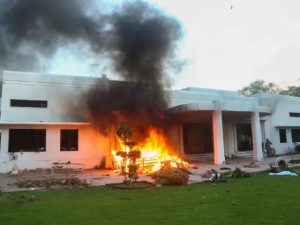
On Thursday, an anti-terrorism court (ATC) in Lahore ordered the Camp Jail superintendent to turn over 16 inmates to the military so that they could begin military court proceedings against them for their roles in an attack on the Lahore corps commander’s residence, also known as Jinnah House, during the protests on May 9. Among those inmates was a former member of the PTI.
The ruling was issued by ATC Judge Abher Gul Khan, who granted the custody of the accused after receiving an application from a superior officer.
An initial investigation “found that the following accused persons were prime movers in the commission of offenses under the provisions of the Official Secrets Act, 1923 read with Section 2(1)(d) and 59(4) of the Pakistan Army Act 1952,” the application stated, listing 16 possible perpetrators.
The primary purpose for which the Army Act of 1952 established military tribunals was the trial of military personnel and foreign adversaries of the United States. Only by decree of the federal government may civilians be prosecuted there. It is possible for civilians to be prosecuted in military courts if they have been accused of war crimes, such as assaulting military sites or encouraging rebellion.
Protesters, some of whom were said to be PTI members, assaulted the General Headquarters in Rawalpindi and the home of the Lahore corps commander on May 9 in an extraordinary act of destruction.
Hours earlier, PTI chairman Imran Khan had been detained from the Islamabad High Court on corruption charges related to the Al-Qadir Trust (later renamed the National Crime Agency £190 million scam) on the instructions of the National Accountability Bureau.
After the riots, the previous ruling party’s officials and employees were subjected to a severe crackdown that is still ongoing.
The army called May 9 a “dark chapter” and declared its intention to trial the demonstrators under the Pakistan Army Act and the Official Secrets Act, both of which are military statutes.
The decision was supported by the NSC, the highest security body in the country. The federal cabinet accepted the decision to try the May 9 protestors under the Army Act and the Official Secrets Act for their looting and vandalism of military facilities.
Local and international rights groups, as well as members of the ruling coalition, all voiced strong opposition to the decision, citing concerns that it would undermine democracy.
Amnesty International has also voiced its disapproval of the Army Act being used to trial the May 9 rioters, stating that “using military courts to try civilians is a clear violation of international law.”
The PTI filed a petition with the Supreme Court on Monday objecting to the use of military tribunals to prosecute civilians, claiming that this would be a “clear violation” of the rights to due process and a fair trial guaranteed by the Constitution.
This type of trial is “widely considered to fall short of providing fair trial,” according to the petition, and is thus “highly deprecated internationally.”
On Thursday, the commanding officer reported that the accused had been remanded to jail on judicial remand after two separate police departments, the Sarwar Road police and the Race Course police, filed two charges against them for destroying public and private buildings, including Jinnah House.
He argued that the accused broke the Official Secrets Act of 1923 (articles 3, 7, and 9), as well as the Pakistan Army Act of 1952 (sections 2(1)(d) and 59(4)).
He argued that the military courts were the only ones having jurisdiction over the accused, and asked that they be turned over to the military for trial.
According to Section 59(4) of the Army Act, “notwithstanding anything contained in this Act or in any other law for the time being in force, a person who becomes subject to this Act by reason of his being accused of an offence mentioned in clause (d) of subsection (1) of Section 2 shall be liable to be tried or otherwise dealt with under this Act for such offence as if the offence were an offence against this Act and not any other law.” Section 2(1)(d) of the Army Act provides further detail on
The court ruled that the prosecution had failed to meet its burden of proof, and the court ordered the superintendent of Camp Jail to turn over all 16 defendants to the commander.
“In view of the request made by Irfan Akhtar, commanding officer/military officer, duly forwarded by the prosecution as the case of above mentioned accused is exclusively triable by military court, therefore, while accepting the request of commanding officer u/s 549(3) of the CrPC read with Rule 7(f) of the Criminal Procedure (Military Offenders) Rules, 1970, the superintendent, Jail Canmp, Lahore is directed to hand over custody of the above said accused
One of the accused was also the ex-MPA for the PTI, Mian Akram Usman.
Authorities have named the following individuals as suspects: Ammar Zohaib, Ali Iftikhar, Ali Raza, Muhammad Arsalan, Muhammad Umair, Muhammad Rahim, Ziaur Rehman, Waqas Ali, Rais Ahmed, Faisal Arshad, Muhammad Bilal, Faheem Haider, Arzam Junaid, Mian Muhammad Akram Usman, Muhammad Hasher Khan, and Hassan Shakir.